Back to School Looking Cool Retro SVG: A Practical Digital Asset for Educators, Creators, and Small Businesses
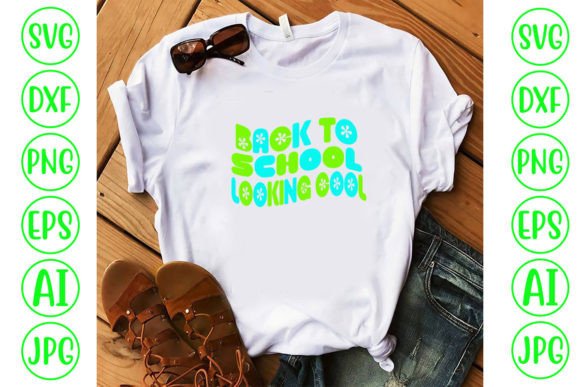
Back to School Looking Cool Retro SVG is a tightly focused digital design asset built for practical application—not nostalgia for its own sake. It’s a layered, multi-format vector file package designed specifically for educators preparing classroom materials, small business owners launching seasonal promotions, crafters producing custom apparel or accessories, and freelance designers building themed content libraries. Unlike generic retro graphics, this file set prioritizes functional layering, cross-platform compatibility, and production-ready clarity—making it a time-saving tool rather than just visual decoration.
What You Actually Get—and Why Format Variety Matters
Your download includes one .zip file containing seven distinct file types: 1 AI (Adobe Illustrator), 1 SVG, 1 PNG, 1 EPS, 1 DXF, 1 JPEG, and Word By Layer SVG Files. That last detail—“Word By Layer”—is the operational core. Each word in the phrase “Back to School Looking Cool” is isolated on its own vector layer, allowing precise control over color, spacing, alignment, animation timing, or selective cutting without manual path separation. This isn’t just convenience—it eliminates hours of prep work when adapting the design for different substrates, devices, or delivery formats.
The inclusion of both SVG and DXF files ensures seamless use with Cricut Design Space and Silhouette Studio, while the AI and EPS files support professional-grade editing in Adobe environments. The PNG and JPEG provide immediate raster fallbacks for social media posts, email headers, or printed handouts where vector support isn’t available. No physical product ships; this is strictly a digital download intended for integration into existing workflows—not display or collection.
Real-World Usability Across Common Scenarios
In classroom settings, teachers use the Word By Layer SVG Files to create differentiated learning tools: swapping out “Cool” for “Ready” or “Excited,” adjusting font weights for readability, or isolating “School” to pair with grade-level icons. One educator reported using the layered structure to build interactive Google Slides activities—animating each word sequentially during morning meetings—without needing external animation software.
For small business owners running school-themed pop-ups or back-to-school sales, the consistent line weight and balanced kerning across all formats mean the same design scales cleanly from a 4-inch iron-on transfer to a 48-inch window decal. The retro aesthetic—clean sans-serif forms with subtle geometric embellishments—avoids dated clichés (think exaggerated chrome or pixelated textures) while retaining enough stylistic character to stand out in crowded digital feeds or local retail environments.
Freelance designers working with education clients appreciate that the AI file retains editable text objects (not outlined paths), enabling quick client revisions without re-importing or re-spacing. Likewise, the DXF version imports reliably into Glowforge and other laser-cutting platforms, preserving layer integrity for multi-material signage projects—something not guaranteed with auto-converted SVGs.
Quality and Consistency: What Holds Up Under Scrutiny
The vector paths are clean and closed, with no stray anchor points or overlapping segments—a critical detail when cutting vinyl or etching glass. Stroke widths remain uniform at any scale, and the color palette uses standard RGB and CMYK-safe values, reducing unexpected shifts between screen and print. Unlike many marketplace SVGs that rely on embedded raster effects or non-standard gradients, this set uses flat fills and native vector strokes only, ensuring predictable rendering across browsers, cutters, and editing applications.
That said, the retro styling does impose mild constraints. The design leans into mid-century modern sensibilities—moderate x-height, open counters, restrained tracking—so it won’t suit ultra-minimalist or high-tech branding contexts without thoughtful adaptation. It also assumes users have basic familiarity with layer management in their chosen software; beginners may need to consult platform-specific guides for toggling visibility or exporting individual layers.
Audience Fit: Who Benefits Most—and When It Might Fall Short
This Back to School Looking Cool Retro SVG serves professionals who value precision, repeatability, and format flexibility over novelty or trend-chasing. Educators building reusable templates benefit most when they plan to deploy the design across multiple grade levels or subject areas. Marketing coordinators for tutoring centers, after-school programs, or school supply retailers find long-term utility in having a single, adaptable asset for banners, social tiles, email headers, and printable checklists—all sourced from one consistent visual foundation.
Small business owners selling custom tumblers, tote bags, or notebooks can integrate the layered words directly into mockup generators or production pipelines, avoiding costly redesigns for each new SKU. Similarly, bloggers covering education tech or creative entrepreneurship use the PNG and JPEG versions for blog headers and Pinterest pins—knowing the source vector allows quick resizing without quality loss.
It’s less suited for users needing photorealistic textures, variable fonts, or animated SVGs with JavaScript interactivity. There’s no built-in motion, no alternate color schemes beyond manual recoloring, and no accompanying icon set or pattern library. If your project requires full brand system expansion—or if you’re sourcing assets for a national campaign with strict accessibility compliance requirements—you’ll need to supplement this file with additional resources.
Practical Integration Tips for Immediate Use
- Cricut users: Import the SVG directly—layers appear as separate elements in the Layers panel. Use “Ungroup” only if needed; the native layer structure preserves grouping logic.
- Silhouette Studio users: Prefer the DXF for cut accuracy on intricate letterforms, especially at sub-2-inch sizes. The SVG works well for Print & Cut jobs.
- Adobe Illustrator users: Open the AI file to access editable text. Save copies before outlining—this preserves future editability across team members.
- Bloggers and social managers: Use the PNG at 2000px width for featured images; compress with Squoosh or TinyPNG before uploading to maintain load speed.
- Educators: Export individual layers as transparent PNGs to build drag-and-drop digital activities in tools like Nearpod or ClassIn.
Ultimately, Back to School Looking Cool Retro SVG earns its place in a working designer’s or educator’s toolkit not because it’s flashy, but because it removes friction. Its layered architecture, consistent output across formats, and intentional retro restraint make it a reliable starting point—not a finished solution. Whether you’re prepping a first-day-of-school bulletin board, designing limited-run merchandise for a local PTA fundraiser, or building a cohesive seasonal content calendar, this asset delivers measurable time savings and visual coherence. As with any digital resource, its value compounds with how deliberately it’s integrated—not how often it’s downloaded.