Back to School Farm Animals Digital Paper
Imagine opening a zip file and finding twelve high-resolution, ready-to-use digital papers—each bursting with cheerful farm animals, school-themed accents, and warm, inviting colors. That’s the core of Back to School Farm Animals Digital Paper: a focused, practical toolkit designed not just for decoration, but for meaningful creative work. It’s not clipart. It’s not a template bundle. It’s intentional background texture—designed to support clarity, reinforce themes, and add warmth without overwhelming your message.
What Makes This More Than Just “Cute Backgrounds”
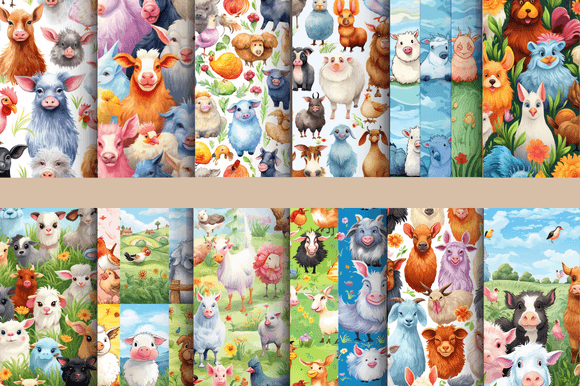
These 12 digital papers are built around a specific, timely intersection: the energy of back-to-school season and the grounded charm of farm life. Think barn-red borders beside chalkboard-style textures, or gentle watercolor pigs nestled into notebook-lined patterns. Each is sized at 8.5×11 inches—optimized for standard printing, digital planning, and easy scaling across platforms. They’re high-resolution (300 DPI), meaning they hold up whether you’re printing classroom posters, designing editable PDF planners, or layering them into Canva social graphics.
Their digital-only nature is a feature—not a limitation. No shipping delays. No inventory tracking. Instant access means you can respond quickly to client requests, adapt lesson plans mid-week, or launch a themed product line before the first bell rings. And because they’re flat-color and texture-based (not photo-heavy), they’re lightweight to download, easy to edit in most design software, and highly compatible with both beginner and pro tools—from Google Slides to Adobe Illustrator.
Creative Applications That Go Beyond the Obvious
Most people reach for digital paper when building printables—but its real strength lies in flexibility. Here’s how different users apply Back to School Farm Animals Digital Paper with intention:
- Educators use the barnyard motifs to soften academic materials—turning behavior charts, reading logs, or homework trackers into welcoming, low-stress tools. One third-grade teacher layered the chicken-and-egg pattern under student goal-setting worksheets; the visual cue helped kids connect effort (“hatching” ideas) with growth.
- Small business owners integrate the papers into branded digital resources—like a homeschool curriculum provider who embedded the cow-print paper into their downloadable lesson kits. The consistency across handouts reinforced trust and made their brand instantly recognizable in parent email inboxes.
- Freelance designers treat them as foundational layers: placing clean white text boxes over the piglet-patterned paper for a newsletter header, or using the tractor-lined version as a subtle border in an editable planner sold on Etsy. It saves hours of custom texture creation while keeping output cohesive.
- Bloggers and content creators repurpose them as slide backgrounds for Pinterest Idea Pins or Instagram carousels about classroom organization. Because the designs are thematic but not overly literal, they appeal to both early childhood educators and rural homeschoolers—broadening reach without diluting focus.
Adapting for Different Goals—and Keeping It Effective
How you use these papers changes based on your audience and format. A kindergarten teacher preparing laminated center signs might print directly from the PDF—choosing the bolder, higher-contrast papers for maximum readability at a glance. Meanwhile, a graphic designer crafting a digital workbook for parents would likely import the files into Photoshop or Figma, adjust opacity, and overlay soft shadows to create depth and hierarchy.
Consistency matters—but so does restraint. Using all 12 papers across one project can feel chaotic. Instead, pick 2–3 that share tonal harmony (e.g., papers with similar base colors or line weights) and rotate them intentionally: one for headers, one for section dividers, one for callout boxes. This builds rhythm without repetition.
Also consider accessibility. While the farm animal motifs are friendly, avoid placing light-colored text directly over busy areas like clustered sheep or overlapping tractor wheels. Use a semi-transparent white overlay or bold sans-serif fonts to ensure legibility—especially for students with visual processing differences or readers viewing on mobile devices.
Realistic Tips for Getting Started
You don’t need advanced skills to begin. Start small:
- Test one paper in your next printable. Open it in Preview (Mac) or Photos (Windows), then drag it into a blank Word or Google Docs file. Add a simple title and bullet list. See how the texture supports—or competes with—your content.
- Print a sample on your home printer. Try matte paper first. Notice how the reds and yellows shift slightly depending on ink type and paper weight. Keep notes: “Works best on 24 lb cardstock,” or “Softer tones show up clearer on glossy.” These observations become part of your production workflow.
- Save edited versions with clear names. Instead of “FarmPaper_03_FINAL_v2_edit,” try “FarmPaper_CowBorder_Header_300DPI.” Clear naming saves time when you revisit files months later—or hand them off to a VA or collaborator.
Remember: digital paper isn’t meant to carry your entire message. It’s the quiet foundation—the visual equivalent of good lighting in a room. It sets tone, guides attention, and adds warmth, but only works when it serves your purpose, not overshadows it.
Why This Fits Real Creative Workflows
In a landscape full of generic “school” or “cute animal” assets, Back to School Farm Animals Digital Paper stands out by balancing specificity with versatility. It doesn’t try to be everything. It’s designed for a narrow window—late summer through early fall—and a clear emotional need: calm preparation, grounded learning, and joyful transition. That focus makes it more useful, not less.
Whether you're assembling a $7 printable pack for Teachers Pay Teachers, drafting a welcome packet for new families at your childcare center, or designing a limited-run journal for homeschool moms, this set gives you a head start—not a finished product. You bring the strategy, the voice, the audience insight. These papers bring cohesion, charm, and professional polish—without demanding extra time or technical overhead.
And because they’re digital, you can test, iterate, and refine fast. Swap a background before sending a proof. Adjust contrast after reviewing on a tablet. Repurpose a single paper across three formats—printable, Notion template, and Canva presentation—without re-downloading or reformatting. That kind of agility is where real creative efficiency begins.